Key Takeaways: Porcelain veneers last longer, resist staining, and deliver a more refined long-term result. Composite costs less and takes fewer appointments but needs more maintenance and will eventually discolour.
Porcelain veneers and composite veneers can both produce genuinely beautiful results. Dr. Jennifer Graas has treated patients with both materials. The right choice depends on your teeth, your timeline, and what you're actually trying to fix.
That said, the two materials are very unique from each other. They age differently, behave differently under pressure, and suit different patients for reasons that aren't always obvious upfront. This comparison is drawn from real cases, not generalizations.
How Porcelain Veneers and Composite Veneers Are Made Differently
Composite veneers are sculpted directly onto your teeth. The dentist applies resin in layers, shapes it by hand, and polishes it to a finish. Most composite cases require no enamel removal and can be completed in a single appointment. The result depends heavily on the clinician's skill, since there's no lab involved. Dr. Graas does her own wax mock-up prior to placing composite veneers for her patients to ensure the best result.
Porcelain veneers are fabricated off-site by a dental ceramist, then bonded to your teeth at a second appointment. The process involves detailed photographs, moulds, and a wax mock-up so you can preview the shape and size before anything is finalized. Traditional porcelain veneers typically require some enamel reduction to ensure a proper fit and a result that doesn't look bulky. How much enamel is removed depends on your tooth anatomy and the scale of the cosmetic change.
Composite vs. Porcelain Veneers: What Changes After a Few Years
The clearest difference between the two materials isn't visible on day one. It shows up over time.
Composite is porous. It absorbs pigment from coffee, red wine, and other staining foods gradually, and the rate varies depending on the bacterial environment in your mouth, not just your diet. Some patients hold their composite veneers well for years; others see noticeable discolouration within two or three years.
Porcelain doesn't stain. The surface is non-porous, so its colour on day one is its colour a decade later, assuming the veneers are well-maintained.
Composite is also more prone to chipping than porcelain, particularly under lateral pressure. Biting your nails, tearing packaging, and eating hard foods with your front teeth: all of these put stress on composite that porcelain handles more readily. It's not that composite is fragile, but it has a lower threshold for the kinds of careless habits most people don't think twice about.
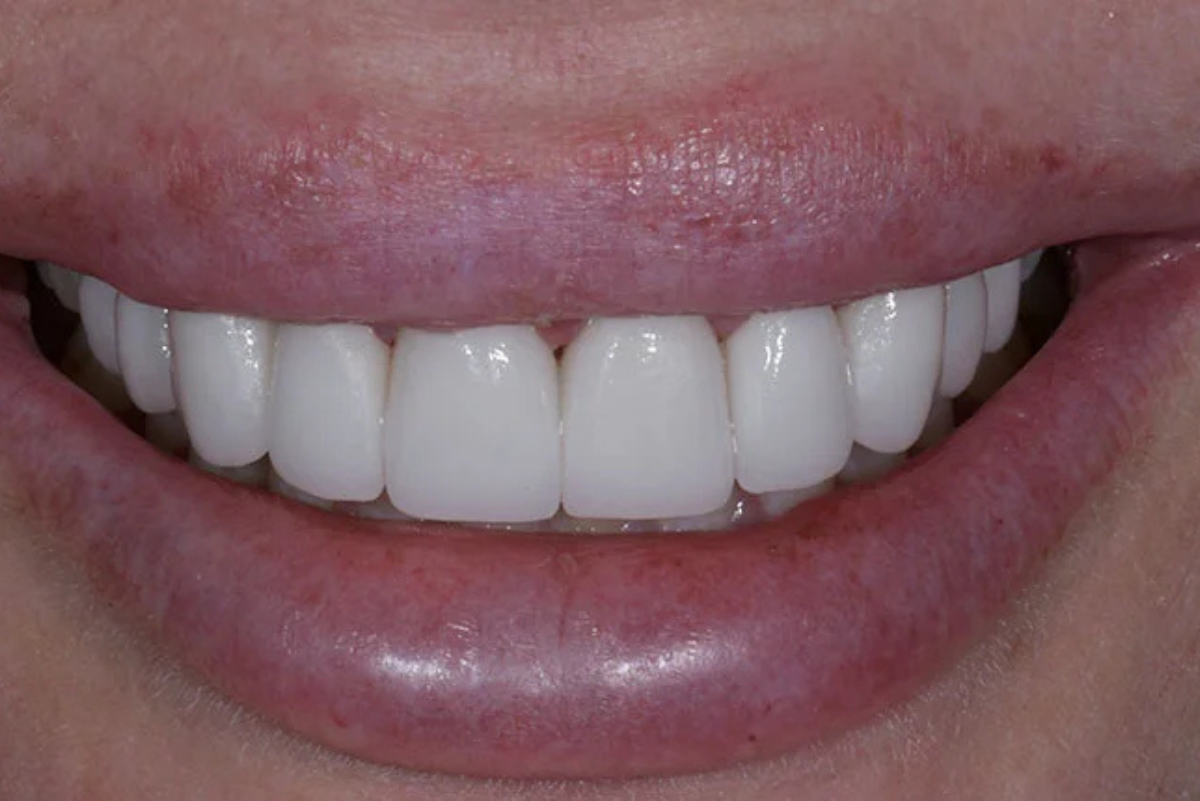
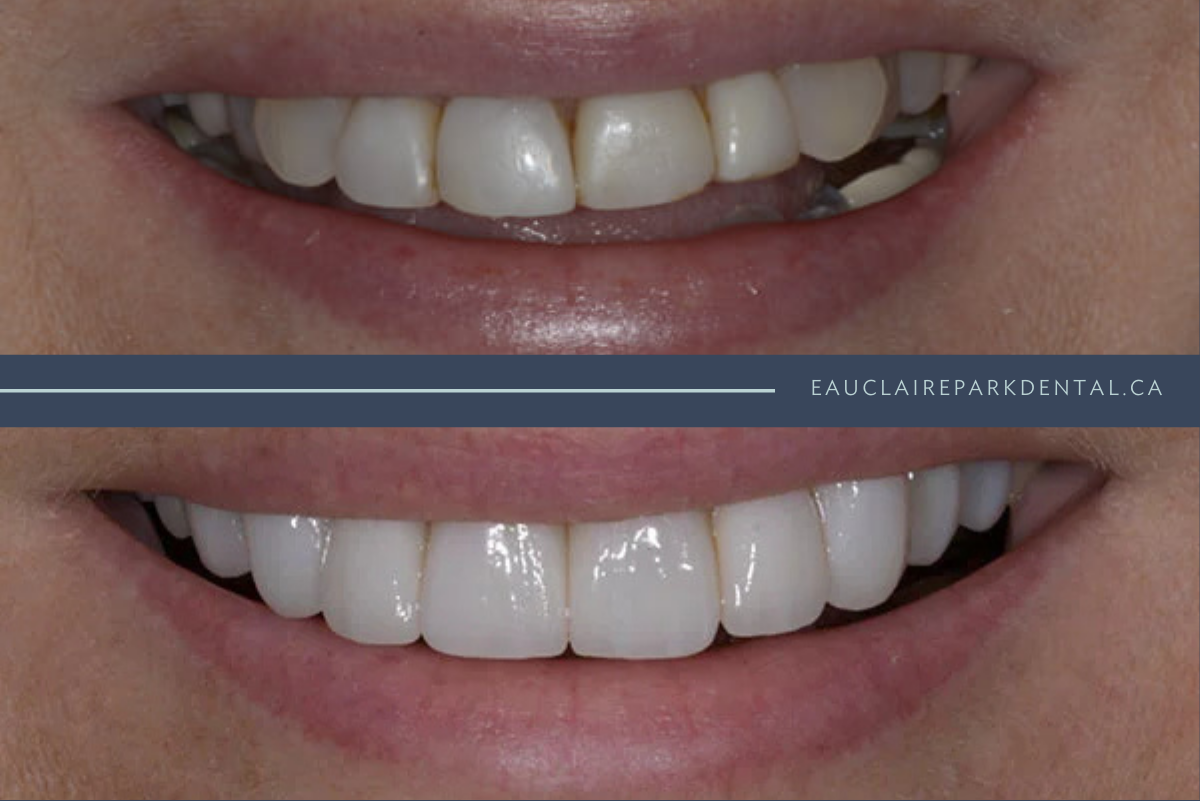
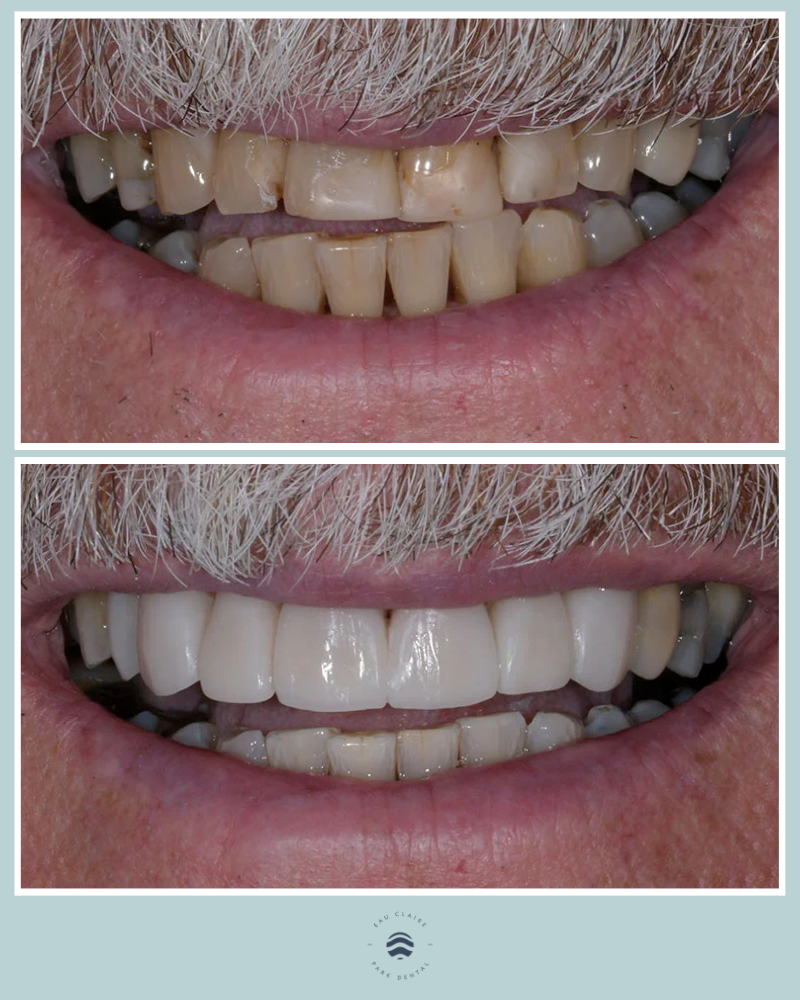
Dr. Graas treated this patient who had composite veneers that had stained significantly over the years. When they were replaced with six porcelain veneers, the improvement was immediate, and the patient's smile looked noticeably more youthful.
That progression from composite to porcelain is one of the more common treatment paths at Eau Claire Park Dental, and it's worth knowing about when you're choosing a material the first time.
Composite Veneers Are Not a Lesser Option
There's a tendency in cosmetic dentistry content to frame composite as the budget fallback. That's not accurate, and it's not how Dr. Graas approaches the decision of composite vs. porcelain veneers.
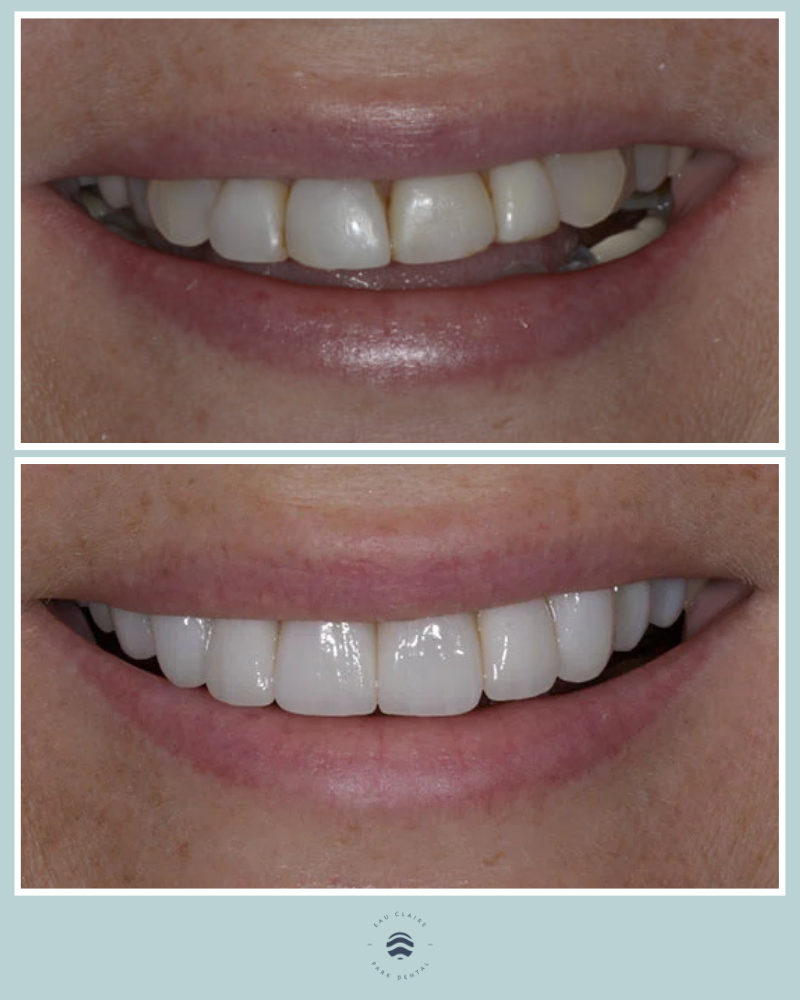
She treated this patient in his early 80s who had old stained composite on his front teeth. Rather than recommending porcelain, Dr. Graas removed the existing composite and rebuilt his teeth in a more ideal shape using fresh resin, with no enamel touched. He tells her at every visit how happy he is and that he only wishes he'd done it sooner. Composite was the right material for his case.
Composite suits patients who:
- Want a meaningful improvement without a long-term commitment
- May want to revisit their cosmetic goals in a few years
- Require modest correction
The procedure is reversible, faster, and less involved than porcelain veneers.
Microthin Porcelain Veneers: No Enamel Removal, Permanent Results
Microthin veneers occupy a specific position in this comparison. They're an ultra-thin porcelain veneer that bonds directly to your natural enamel, with no drilling and no removal of tooth structure. Because your enamel stays completely intact underneath, the procedure is reversible in a way traditional porcelain veneers are not.
Dr. Graas is certified to place Microthin veneers, and she works with a specialized lab in California for each case.
Not everyone qualifies for Microthin veneers. Teeth that protrude significantly do not have room to accommodate the added thickness without looking unnatural. Candidacy depends on your bite, your enamel health, how large your teeth are, and what you're trying to correct. For patients who do qualify, it's a genuinely different option from anything else currently available in Calgary.
Porcelain Veneers vs. Composite Veneers vs. Microthin: Side by Side
| Yes | No | Yes | |
| Moderate | |||
Which Veneer Type Is Right for Your Teeth?
Porcelain veneers are worth the investment when longevity and stain resistance are priorities, when the colour correction needed is significant, or when a patient has already been through composite and wants a more durable result. The process is more involved, but over a 10- to 15-year horizon, porcelain typically requires less intervention.
Composite veneers make the most sense when the change being made is modest, when flexibility matters more than permanence, or when budget is a genuine constraint. It's also the more practical choice for patients who want to test a cosmetic change before committing to a permanent restoration.
One thing that doesn't change by material: if your bite has significant misalignment, that needs to be addressed before veneers of any kind are placed. Putting veneers on poorly aligned teeth requires more tooth reduction to compensate, which compromises both the result and its longevity.
For patients considering veneers as part of a broader smile improvement, learn how cosmetic and restorative dental treatment work together.
Caring for Porcelain and Composite Veneers Long-Term
Both materials follow the same core maintenance principles: a soft-bristled toothbrush, non-abrasive toothpaste, daily flossing, and regular professional cleanings.
For composite specifically, more frequent cleanings help guard against staining. A custom nightguard is worth it for patients who grind or clench, regardless of which material they choose.
At-home whitening products won't change the colour of either material, and for both composite and porcelain, harsh formulas can affect the surface finish. The full maintenance guide for both veneer types is here.
Frequently Asked Questions About Porcelain Veneers vs. Composite
What's the difference between composite and porcelain veneers?
Composite veneers are made from resin and applied directly to teeth in a single appointment, with no lab work required. Porcelain veneers are custom-fabricated in a dental laboratory and bonded at a second visit. Porcelain resists staining and generally delivers a more refined long-term result. Composite costs less and typically requires no enamel removal.
Are porcelain veneers better than composite?
For long-term durability and stain resistance, porcelain has clear advantages. Composite is a legitimate choice for patients who want a reversible option, fewer appointments, or a lower upfront cost. Which material is better depends entirely on the individual patient's anatomy, goals, and timeline.
How long do composite veneers last compared to porcelain veneers?
Composite veneers typically last 5 to 7 years before needing significant repair/polishing or replacement. Porcelain veneers last 10 to 15 years or more with proper care. Composite is also more susceptible to staining over time. The rate of discolouration depends on diet and the bacterial environment in your mouth, so it varies considerably between patients.
What are Microthin veneers?
Microthin veneers are ultra-thin porcelain veneers that bond to your natural enamel with no drilling and no removal of tooth structure. Because the procedure doesn't alter your enamel, it's reversible, which traditional porcelain veneers are not.
Can composite veneers be replaced with porcelain veneers?
Yes, and it's a common treatment path. As composite ages and stains, many patients upgrade to porcelain veneers for a longer-lasting result. Dr. Graas removes the existing composite and replaces it with custom porcelain fabricated by a dental ceramist.
Do porcelain veneers require removing enamel?
Traditional porcelain veneers typically require some enamel reduction. How much varies by case. Microthin veneers are the exception: they're thin enough to bond directly to natural enamel with no removal required, making them the most conservative porcelain veneer option available.
Book a Veneer Consultation at Eau Claire Park Dental
Dr. Graas has placed both composite and porcelain veneers across hundreds of cases. Her recommendation is always the one that suits your teeth, your bite, and your goals—not the one that's most expensive or most involved.
To book a consultation, call 403-263-6340 or request an appointment online.
If you'd like to see real patient results before your visit, the smile gallery is a good starting point.